Showing posts with label Criticism. Show all posts
Showing posts with label Criticism. Show all posts
Thursday, 1 February 2018


Wednesday, 17 January 2018
Explain Law of Probability and necessity? "Aristotle Poetics"
LAW OF PROBABILITY AND NECESSITY:
The law of probability in terms of tragedy simply means the probability that a given character will react to a given situation is high because of human nature. Aristotle argued that the 'Universality' of human nature dictates the probability of a character's reaction in a specific circumstance,
"A character must act in accordance with human nature - either through probability, i.e. what 'most of us' would do, or through necessity, i.e. what we are 'forced' to do. An action cannot seem arbitrary - otherwise not only will it violate the determinate structure and break unity, but it will also irritate an audience that sees no basis for the action in human behavior. "
So, for example, when Horatio sees Hamlet (and just about everyone else) dead at the end of the play, his immediate reaction is to kill himself. Suicide is a probable and plausible idea for Horatio to think about given the circumstance.
The poet, as has been already remarked, imposes order on the confused tangle of life. The poet eliminates the irrelevant matter, the nonessential, or the merely incidental. The law of probability and necessity refers to the internal structure of the poem. It brings about the close cohesion of the parts. There has got to be a ‘necessity’ about the events following one another. There has to be a ‘necessary’ relationship between the events, and between the characters and events. There is a probably causal relationship between the incidents.
One might argue that this kind of order and design is far removed from real life, in which things often happen without apparent cause. Things often happen in a haphazard manner, with no proper causal relationship in life. Why, then, should we say that poetry’s truth depends upon the law of probability and necessity, or order and the establishment of proper relationship between cause and effect ? The very fact that the poet selects his material and imposes order on it, and produces an effect of ‘inevitability’ about the sequence of events, embodies the essence of poetic truth. It is through this process of ordering the material into a cohesive whole that a poet achieves the idealization of appearances. The poet takes the haphazard material of the life as we see it. He imagines a cohesive while composed out of this material. He creates this cohesive whole out of the chaotic material. Thus the truth embodied in poetry is of a higher order than that of history.
Imaginative Truth
The men and women we meet in poetry are not ‘real’ in the usual sense of term. They are always slightly different, either better or lower than average. Their thoughts and words are not thoughts and words of ordinary men and women. The probable laws of their behaviour cannot be measured against the standards of average humanity. The rules of ordinary experience do not govern the higher creations of- poetry. Poetry imitates the ‘essence’ and not the appearances. It reveals the ideal possibilities inherent in human life. All that the truth of poetry demands is that the actions of the character in the poem be logical. The events presented by the poet should have a relationship not only with one another, but also with the character placed in the midst of these events. Aristotle agrees that poetry presents not facts, but fiction. But this does not make poetry ‘unreal’ or ‘untrue’. The truth of poetry is a “higher reality*, because poetry rises above facts. In this it becomes ‘ideal’; it presents something as it might have been, or ought to be, according to the idea of the poet. It is the imaginative power which makes poetic truth different from historical truth. And it is this that makes poetry ‘universal’ and permanent in its truth.
"Magenta"]Likely Impossibility is Preferable to Unlikely Possibility
Aristotle makes a valid statement in connection with poetic truth. He remarks that in pftetry the ‘likely impossibility is preferable to the ‘unlikely possibility’. The poet, Aristotle is quite willing to admit, tells lies; the poet is not concerned with actualities. But what matters, tells lies; the poet is not concerned with actualities. But what matters, is the way of telling these lies. It is of the utmost importance that these ‘lies’ be convincing, credible, probable. The most impossible occurrence, incident, or character becomes credible through the poet’s vivid handling. Indeed, we find that we are quite willing to believe the ‘fantastic’ in actual life even if it seems quite unlikely. But the same thing would appear incredible in art, if it is not presented in a ‘realistic’ manner. Poetic illusion has to be created with a master-touch, otherwise the required ‘suspension of disbelief will not be produced. It is’the poet’s artistic capabilities which can create this poetic illusion, by ordering the events in a causal sequence. It would then appear as if the events could have happened under a particular set of circumstances. Through the poet’s art, “the impossible not only becomes possible, but natural and even inevitable.”
Kinds of Improbabilities and Irrationalities
The probable is that which appears rational, and hence gains our credibility. Anything improbable is irrational. The impossible is that which is not possible physically. But the impossible can be made to look ‘probable’ if it is given a logical inevitability through art. The improbable does not really have a place in art. But there are some types of improbabilities which can be overcome in their presentation.
Material improbability, with regards to material facts, can be overcome. It can be made to look logically inevitable by artistic skill. Improbabilities are admitted in poetry as they are conducive to the heightening of the poetic effects of wonder and admiration. Homer, says Aristotle, could handle ‘lies’ very well.
The ‘irrational’ is much more difficult to handle if it is the introduction of the marvellous. But the supernatural elements are easily believed, if it is in accordance with the general beliefs and received opinion. The supernatural elements are easily admittable in epic poetry, but less so in tragedy which is presented on stage. On stage, irrationalities appear less credible.
In dramatic poetry, the events presented must be the logical and natural outcome of the preceding events. Each event has to lead naturally to the next. There is a complex interelationship between character and event in drama. Cause and effect have to be logically presented. Hence, the place for the irrational, the supernatural, and the marvellous is highly restricted in drama. Nor is there much place for ‘chance’ or ‘accident’. Chance events do not have rationality while drama requires its events to be governed by the law of probability and necessity. Chance is allowed only if the poet’s great skill can overcome its apparent irrationality.
Moral Improbability
The one kind of improbability which cannot be overcome through the skill of any poet is ‘moral improbability’. This is the improbability arising out of the violation of the basic laws of human behaviour. These violate the very principles of human nature, and do not have a place in poetry at all. They cannot be glossed1 over by any skilful technique, for they are absolutely untrue, conceptually2 or really. Artistic truth depends on the basic truths of human nature—the eternal emotions, thoughts, feeling, and actions of human beings. If it violates these very objects of imitation, it cannot have any credibility. Logical and moral necessity are at all times to be adhered to.
Conclusion
Poetry then, is ‘imitation’, but not a photographic presentation of the world of appearances and all its mundane trivialities. Poetry’s truth is based on the basic elements of human nature, the everlasting, universal aspects of human life. Poetry ignores the non-essentials, removes irrelevances, and concentrates on the essentials. It presents the ‘universal’, while history deals with particular events. Poetry takes the particular and makes it into the universal. But the process of imitation is in keeping with the law of logicality, probability and necessity. Poetic truth is higher than that of history. The particular object taken by the poet is transfigured, “so that the higher truth, the idea of the universal, shines thought it”. Aristotle defends poetry against the charge that it is full of lies.
Aristotle enunciates a doctrine which holds good for all ages—*the presence of a universal element in all great .poetry, accounting for its permanent appeal, while at the same time he showed how a reconciliation might be effected between poetry and philosophy. “Plato had indeed shown that an element of intuition was common to the processes of philosopher and poet alike; but it remained for Aristotle to complete the vindication of poetry, and to recommend the claims of philosophy and poetry by showing that both were avenues to the higher truth.”
Write constituents or elements of tragedy?
Aristotle’s Elements of Tragedy
Aristotle said that tragedy has six main elements:
1. Plot; 2. Character; 3. Thought;
4. Diction; 5. Melody; 6. Spectacle.
These will be described from least important to most important.
The last four elements (Thought, Diction, Melody, and Spectacle) are the least important, but Aristotle felt they must
be done well for the play to succeed.
Thought is the power of saying whatever can be said and should be said at each moment of the plot. Do the lines
spoken by the actors make sense? Are they saying what should be said at each particular moment in the play?
Diction is the actual composition of the lines that are recited. Thought deals with what is said, and diction deals with how it is said. There are many ways to say something. A good playwright composes lines that say something
extremely well. In a good play, some lines are so well constructed that the audience can leave the play quoting the
lines exactly.
Melody and Spectacle are accessories. The Greeks sometime s used musical accomp animent. Aristotle said the music
(melody) has to blend in with the p lay appropriately. Spectac le refers to the staging of the play . Again, as with melody, the spectacle should be appropriate to the theme of the play.
Character
Character is the second most important element of tragedy. Each character has an essential quality or nature that is
revealed in the plot. The moral purpose o f each character must be clear to the audience. Th e characters should have four main qualities.
A. No matter who they are (hero or slave), the characters must be good in some way.
B. The characters should act appropriately for their gender and station in life.
C. The characters have to have believable personalities.
D. Each character must act consistently throughout the play. In other words, nothing should be done or said
that could be seen as “acting out of character.”
Plot
Aristotle felt that the action of the play (its plot) was the most important of the six elements.
He said, “All human happiness or misery takes the form of action... .Character gives us qualities, but it is in our
actions--what we do--that we are happy or miserable.”
1. There must be Unity of Plot. This has a lready bee n described in the definitio n which talks about “one complete
action.” Any events or episodes must be necessary to the main issue and must also be probable or believable.2. A good plot has Peripety or Discovery--sometimes both.
Peripety is the change from one state of things at the beginning of the play to the exact opposite
state by the end of the play. This could be something like the change from being rich to being poor, or from
being powerful to being powerless, or from being a ruler to being a beggar. The change that takes place in a
tragedy should take the main character (and possibly other characters) from a state of happiness to a state of
misery.
Discovery is a change from ignorance to knowled ge. This often happens to the tragic hero who starts out
“clueless” and slowly learns how he himself created the mess he ends up in at the end of the play.
3. Change by itself is not enough. The character involved in the change must have specific characteristics to arouse
the tragic emotions of pity and fear. Therefore, Aristotle said that there are three forms of plot that should be
avoided.
A. A totally good man must not pa ss from happiness to misery.
This will make the audience angry that bad things happened to him. They won’t pity him so much as be
angry for him.
B. A bad man mu st not pass from misery to hap piness.
This won’t appeal to the audience at all because they won’t want to see evil rewarded.
C. A bad man can not pass from happiness to misery.
The audience won’t feel sorry for him because they will believe he got what he deserved.
The true tragic hero cannot be too good or too bad, but he must end up in misery.
Aristotle concluded that the be st tragedy centers on a basically good man who changes from happiness to misery
because of some great error. For example, he might have a good quality, like pride, that gets out of hand.
4. The plot of a tragedy also involves some horrible or evil deed. Th e tragic hero either does it consciously, does it out
of ignorance, or mediates it (makes it easy for the deed to happen). For the audience to be horrified by the evil deed,
the evil has to be done to someone important to the tragic hero. If the hero kills his enemy, the deed won’t seem so
bad. On the other hand, if the hero kills someone he doesn't care about, the audience won’t care much either.
Aristotle said that tragedy has six main elements:
1. Plot; 2. Character; 3. Thought;
4. Diction; 5. Melody; 6. Spectacle.
These will be described from least important to most important.
The last four elements (Thought, Diction, Melody, and Spectacle) are the least important, but Aristotle felt they must
be done well for the play to succeed.
Thought is the power of saying whatever can be said and should be said at each moment of the plot. Do the lines
spoken by the actors make sense? Are they saying what should be said at each particular moment in the play?
Diction is the actual composition of the lines that are recited. Thought deals with what is said, and diction deals with how it is said. There are many ways to say something. A good playwright composes lines that say something
extremely well. In a good play, some lines are so well constructed that the audience can leave the play quoting the
lines exactly.
Melody and Spectacle are accessories. The Greeks sometime s used musical accomp animent. Aristotle said the music
(melody) has to blend in with the p lay appropriately. Spectac le refers to the staging of the play . Again, as with melody, the spectacle should be appropriate to the theme of the play.
Character
Character is the second most important element of tragedy. Each character has an essential quality or nature that is
revealed in the plot. The moral purpose o f each character must be clear to the audience. Th e characters should have four main qualities.
A. No matter who they are (hero or slave), the characters must be good in some way.
B. The characters should act appropriately for their gender and station in life.
C. The characters have to have believable personalities.
D. Each character must act consistently throughout the play. In other words, nothing should be done or said
that could be seen as “acting out of character.”
Plot
Aristotle felt that the action of the play (its plot) was the most important of the six elements.
He said, “All human happiness or misery takes the form of action... .Character gives us qualities, but it is in our
actions--what we do--that we are happy or miserable.”
1. There must be Unity of Plot. This has a lready bee n described in the definitio n which talks about “one complete
action.” Any events or episodes must be necessary to the main issue and must also be probable or believable.2. A good plot has Peripety or Discovery--sometimes both.
Peripety is the change from one state of things at the beginning of the play to the exact opposite
state by the end of the play. This could be something like the change from being rich to being poor, or from
being powerful to being powerless, or from being a ruler to being a beggar. The change that takes place in a
tragedy should take the main character (and possibly other characters) from a state of happiness to a state of
misery.
Discovery is a change from ignorance to knowled ge. This often happens to the tragic hero who starts out
“clueless” and slowly learns how he himself created the mess he ends up in at the end of the play.
3. Change by itself is not enough. The character involved in the change must have specific characteristics to arouse
the tragic emotions of pity and fear. Therefore, Aristotle said that there are three forms of plot that should be
avoided.
A. A totally good man must not pa ss from happiness to misery.
This will make the audience angry that bad things happened to him. They won’t pity him so much as be
angry for him.
B. A bad man mu st not pass from misery to hap piness.
This won’t appeal to the audience at all because they won’t want to see evil rewarded.
C. A bad man can not pass from happiness to misery.
The audience won’t feel sorry for him because they will believe he got what he deserved.
The true tragic hero cannot be too good or too bad, but he must end up in misery.
Aristotle concluded that the be st tragedy centers on a basically good man who changes from happiness to misery
because of some great error. For example, he might have a good quality, like pride, that gets out of hand.
4. The plot of a tragedy also involves some horrible or evil deed. Th e tragic hero either does it consciously, does it out
of ignorance, or mediates it (makes it easy for the deed to happen). For the audience to be horrified by the evil deed,
the evil has to be done to someone important to the tragic hero. If the hero kills his enemy, the deed won’t seem so
bad. On the other hand, if the hero kills someone he doesn't care about, the audience won’t care much either.


Aristotle's concept of catharsis
Aristotle writes that the function of tragedy is to arouse the emotions of pity and fear, and to affect the Katharsis of these emotions. Aristotle has used the term Katharsis only once, but no phrase has been handled so frequently by critics, and poets. Aristotle has not explained what exactly he meant by the word, nor do we get any help from the Poetics. For this reason, help and guidance has to be taken from his other works. Further, Katharsis has three meaning. It means ‘purgation’, ‘purification’, and ‘clarification’, and each critic has used the word in one or the other senses. All agree that Tragedy arouses fear and pity, but there are sharp differences as to the process, the way by which the rousing of these emotions gives pleasure.
Katharsis has been taken as a medical metaphor, ‘purgation’, denoting a pathological effect on the soul similar to the effect of medicine on the body. This view is borne out by a passage in the Politics where Aristotle refers to religious frenzy being cured by certain tunes which excite religious frenzy. In Tragedy:
“…pity and fear, artificially stirred the latent pity and fear which we bring with us from real life.”
In the Neo-Classical era, Catharsis was taken to be an allopathic treatment with the unlike curing unlike. The arousing of pity and fear was supposed to bring about the purgation or ‘evacuation’ of other emotions, like anger, pride etc. As Thomas Taylor holds:
“We learn from the terrible fates of evil men to avoid the vices they manifest.”
F. L. Lucas rejects the idea that Katharsis is a medical metaphor, and says that:
“The theatre is not a hospital.”
Both Lucas and Herbert Reed regard it as a kind of safety valve. Pity and fear are aroused, we give free play to these emotions which is followed by emotional relief. I. A. Richards’ approach to the process is also psychological. Fear is the impulse to withdraw and pity is the impulse to approach. Both these impulses are harmonized and blended in tragedy and this balance brings relief and repose.
The ethical interpretation is that the tragic process is a kind of lustration of the soul, an inner illumination resulting in a more balanced attitude to life and its suffering. Thus John Gassner says that a clear understanding of what was involved in the struggle, of cause and effect, a judgment on what we have witnessed, can result in a state of mental equilibrium and rest, and can ensure complete aesthetic pleasure. Tragedy makes us realize that divine law operates in the universe, shaping everything for the best.
During the Renaissance, another set of critics suggested that Tragedy helped to harden or ‘temper’ the emotions. Spectators are hardened to the pitiable and fearful events of life by witnessing them in tragedies.
Humphrey House rejects the idea of ‘purgation’ and forcefully advocates the ‘purification’ theory which involves moral instruction and learning. It is a kind of ‘moral conditioning’. He points out that, ‘purgation means cleansing’.
According to ‘the purification’ theory, Katharsis implies that our emotions are purified of excess and defect, are reduced to intermediate state, trained and directed towards the right objects at the right time. The spectator learns the proper use of pity, fear and similar emotions by witnessing tragedy. Butcher writes:
“The tragic Katharsis involves not only the idea of emotional relief, but the further idea of purifying the emotions so relieved.”
The basic defect of ‘purgation’ theory and ‘purification’ theory is that they are too much occupied with the psychology of the audience. Aristotle was writing a treatise not on psychology but on the art of poetry. He relates ‘Catharsis’ not to the emotions of the spectators but to the incidents which form the plot of the tragedy. And the result is the “clarification” theory.
The paradox of pleasure being aroused by the ugly and the repellent is also the paradox involved in tragedy. Tragic incidents are pitiable and fearful.
They include horrible events as a man blinding himself, a wife murdering her husband or a mother slaying her children and instead of repelling us produce pleasure. Aristotle clearly tells us that we should not seek for every pleasure from tragedy, “but only the pleasure proper to it”. ‘Catharsis’ refers to the tragic variety of pleasure. The Catharsis clause is thus a definition of the function of tragedy, and not of its emotional effects on the audience.
Imitation does not produce pleasure in general, but only the pleasure that comes from learning, and so also the peculiar pleasure of tragedy. Learning comes from discovering the relation between the action and the universal elements embodied in it. The poet might take his material from history or tradition, but he selects and orders it in terms of probability and necessity, and represents what, “might be”. He rises from the particular to the general and so is more universal and more philosophical. The events are presented free of chance and accidents which obscure their real meaning. Tragedy enhances understanding and leaves the spectator ‘face to face with the universal law’.
Thus according to this interpretation, ‘Catharsis’ means clarification of the essential and universal significance of the incidents depicted, leading to an enhanced understanding of the universal law which governs human life and destiny, and such an understating leads to pleasure of tragedy. In this view, Catharsis is neither a medical, nor a religious or moral term, but an intellectual term. The term refers to the incidents depicted in the tragedy and the way in which the poet reveals their universal significance.
The clarification theory has many merits. Firstly, it is a technique of the tragedy and not to the psychology of the audience. Secondly, the theory is based on what Aristotle says in the Poetics, and needs no help and support of what Aristotle has said in Politics and Ethics. Thirdly, it relates Catharsis both to the theory of imitation and to the discussion of probability and necessity. Fourthly, the theory is perfectly in accord with current aesthetic theories.
According to Aristotle the basic tragic emotions are pity and fear and are painful. If tragedy is to give pleasure, the pity and fear must somehow be eliminated. Fear is aroused when we see someone suffering and think that similar fate might befall us. Pity is a feeling of pain caused by the sight of underserved suffering of others. The spectator sees that it is the tragic error or Hamartia of the hero which results in suffering and so he learns something about the universal relation between character and destiny.
To conclude, Aristotle's conception of Catharsis is mainly intellectual. It is neither didactic nor theoretical, though it may have a residual theological element. Aristotle's Catharsis is not a moral doctrine requiring the tragic poet to show that bad men come to bad ends, nor a kind of theological relief arising from discovery that God’s laws operate invisibly to make all things work out for the best.


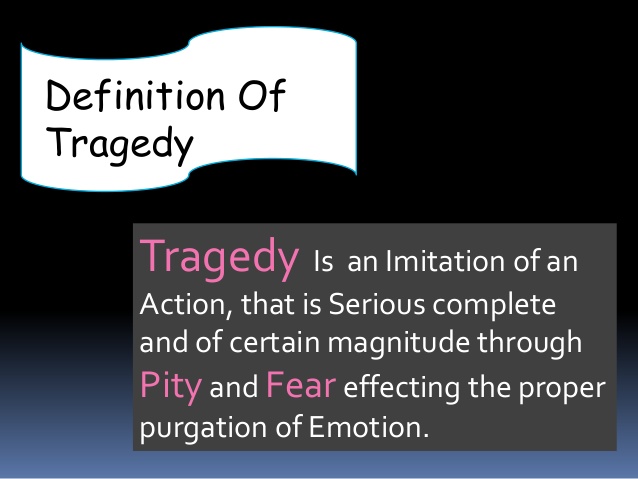


Katharsis has been taken as a medical metaphor, ‘purgation’, denoting a pathological effect on the soul similar to the effect of medicine on the body. This view is borne out by a passage in the Politics where Aristotle refers to religious frenzy being cured by certain tunes which excite religious frenzy. In Tragedy:
“…pity and fear, artificially stirred the latent pity and fear which we bring with us from real life.”
In the Neo-Classical era, Catharsis was taken to be an allopathic treatment with the unlike curing unlike. The arousing of pity and fear was supposed to bring about the purgation or ‘evacuation’ of other emotions, like anger, pride etc. As Thomas Taylor holds:
“We learn from the terrible fates of evil men to avoid the vices they manifest.”
F. L. Lucas rejects the idea that Katharsis is a medical metaphor, and says that:
“The theatre is not a hospital.”
Both Lucas and Herbert Reed regard it as a kind of safety valve. Pity and fear are aroused, we give free play to these emotions which is followed by emotional relief. I. A. Richards’ approach to the process is also psychological. Fear is the impulse to withdraw and pity is the impulse to approach. Both these impulses are harmonized and blended in tragedy and this balance brings relief and repose.
The ethical interpretation is that the tragic process is a kind of lustration of the soul, an inner illumination resulting in a more balanced attitude to life and its suffering. Thus John Gassner says that a clear understanding of what was involved in the struggle, of cause and effect, a judgment on what we have witnessed, can result in a state of mental equilibrium and rest, and can ensure complete aesthetic pleasure. Tragedy makes us realize that divine law operates in the universe, shaping everything for the best.
During the Renaissance, another set of critics suggested that Tragedy helped to harden or ‘temper’ the emotions. Spectators are hardened to the pitiable and fearful events of life by witnessing them in tragedies.
Humphrey House rejects the idea of ‘purgation’ and forcefully advocates the ‘purification’ theory which involves moral instruction and learning. It is a kind of ‘moral conditioning’. He points out that, ‘purgation means cleansing’.
According to ‘the purification’ theory, Katharsis implies that our emotions are purified of excess and defect, are reduced to intermediate state, trained and directed towards the right objects at the right time. The spectator learns the proper use of pity, fear and similar emotions by witnessing tragedy. Butcher writes:
“The tragic Katharsis involves not only the idea of emotional relief, but the further idea of purifying the emotions so relieved.”
The basic defect of ‘purgation’ theory and ‘purification’ theory is that they are too much occupied with the psychology of the audience. Aristotle was writing a treatise not on psychology but on the art of poetry. He relates ‘Catharsis’ not to the emotions of the spectators but to the incidents which form the plot of the tragedy. And the result is the “clarification” theory.
The paradox of pleasure being aroused by the ugly and the repellent is also the paradox involved in tragedy. Tragic incidents are pitiable and fearful.
They include horrible events as a man blinding himself, a wife murdering her husband or a mother slaying her children and instead of repelling us produce pleasure. Aristotle clearly tells us that we should not seek for every pleasure from tragedy, “but only the pleasure proper to it”. ‘Catharsis’ refers to the tragic variety of pleasure. The Catharsis clause is thus a definition of the function of tragedy, and not of its emotional effects on the audience.
Imitation does not produce pleasure in general, but only the pleasure that comes from learning, and so also the peculiar pleasure of tragedy. Learning comes from discovering the relation between the action and the universal elements embodied in it. The poet might take his material from history or tradition, but he selects and orders it in terms of probability and necessity, and represents what, “might be”. He rises from the particular to the general and so is more universal and more philosophical. The events are presented free of chance and accidents which obscure their real meaning. Tragedy enhances understanding and leaves the spectator ‘face to face with the universal law’.
Thus according to this interpretation, ‘Catharsis’ means clarification of the essential and universal significance of the incidents depicted, leading to an enhanced understanding of the universal law which governs human life and destiny, and such an understating leads to pleasure of tragedy. In this view, Catharsis is neither a medical, nor a religious or moral term, but an intellectual term. The term refers to the incidents depicted in the tragedy and the way in which the poet reveals their universal significance.
The clarification theory has many merits. Firstly, it is a technique of the tragedy and not to the psychology of the audience. Secondly, the theory is based on what Aristotle says in the Poetics, and needs no help and support of what Aristotle has said in Politics and Ethics. Thirdly, it relates Catharsis both to the theory of imitation and to the discussion of probability and necessity. Fourthly, the theory is perfectly in accord with current aesthetic theories.
According to Aristotle the basic tragic emotions are pity and fear and are painful. If tragedy is to give pleasure, the pity and fear must somehow be eliminated. Fear is aroused when we see someone suffering and think that similar fate might befall us. Pity is a feeling of pain caused by the sight of underserved suffering of others. The spectator sees that it is the tragic error or Hamartia of the hero which results in suffering and so he learns something about the universal relation between character and destiny.
To conclude, Aristotle's conception of Catharsis is mainly intellectual. It is neither didactic nor theoretical, though it may have a residual theological element. Aristotle's Catharsis is not a moral doctrine requiring the tragic poet to show that bad men come to bad ends, nor a kind of theological relief arising from discovery that God’s laws operate invisibly to make all things work out for the best.
Aristotle's theory of imitation
Aristotle did not invent the term “imitation”. Plato was the first to use the word in relation with poetry, but Aristotle breathed into it a new definite meaning. So poetic imitation is no longer considered mimicry, but is regarded as an act of imaginative creation by which the poet, drawing his material from the phenomenal world, makes something new out of it.
In Aristotle's view, principle of imitation unites poetry with other fine arts and is the common basis of all the fine arts. It thus differentiates the fine arts from the other category of arts. While Plato equated poetry with painting, Aristotle equates it with music. It is no longer a servile depiction of the appearance of things, but it becomes a representation of the passions and emotions of men which are also imitated by music. Thus Aristotle by his theory enlarged the scope of imitation. The poet imitates not the surface of things but the reality embedded within. In the very first chapter of the Poetic, Aristotle says:
“Epic poetry and Tragedy, Comedy also and Dithyrambic poetry, as also the music of the flute and the lyre in most of their forms, are in their general conception modes of imitation. They differ however, from one another in three respects – their medium, the objects and the manner or mode of imitation, being in each case distinct.”
The medium of the poet and the painter are different. One imitates through form and colour, and the other through language, rhythm and harmony. The musician imitates through rhythm and harmony. Thus, poetry is more akin to music. Further, the manner of a poet may be purely narrative, as in the Epic, or depiction through action, as in drama. Even dramatic poetry is differentiated into tragedy and comedy accordingly as it imitates man as better or worse.
Aristotle says that the objects of poetic imitation are “men in action”. The poet represents men as worse than they are. He can represent men better than in real life based on material supplied by history and legend rather than by any living figure. The poet selects and orders his material and recreates reality. He brings order out of Chaos. The irrational or accidental is removed and attention is focused on the lasting and the significant. Thus he gives a truth of an ideal kind. His mind is not tied to reality:
“It is not the function of the poet to relate what has happened but what may happen – according to the laws of probability or necessity.”
History tells us what actually happened; poetry what may happen. Poetry tends to express the universal, history the particular. In this way, he exhibits the superiority of poetry over history. The poet freed from the tyranny of facts, takes a larger or general view of things, represents the universal in the particular and so shares the philosopher’s quest for ultimate truth. He thus equates poetry with philosophy and shows that both are means to a higher truth. By the word ‘universal’ Aristotle signifies:
“How a person of a certain nature or type will, on a particular occasion, speak or act, according to the law of probability or necessity.”
The poet constantly rises from the particular to the general. He studies the particular and devises principles of general application. He exceeds the limits of life without violating the essential laws of human nature.
Elsewhere Aristotle says, “Art imitates Nature”. By ‘Nature’ he does not mean the outer world of created things but “the creative force, the productive principle of the universe.” Art reproduce mainly an inward process, a physical energy working outwards, deeds, incidents, situation, being included under it so far as these spring from an inward, act of will, or draw some activity of thought or feeling. He renders men, “as they ought to be”.
The poet imitates the creative process of nature, but the objects are “men in action”. Now the ‘action’ may be ‘external’ or ‘internal’. It may be the action within the soul caused by all that befalls a man. Thus, he brings human experiences, emotions and passions within the scope of poetic imitation. According to Aristotle's theory, moral qualities, characteristics, the permanent temper of the mind, the temporary emotions and feelings, are all action and so objects of poetic imitation.
Poetry may imitate men as better or worse than they are in real life or imitate as they really are. Tragedy and epic represent men on a heroic scale, better than they are, and comedy represents men of a lower type, worse than they are. Aristotle does not discuss the third possibility. It means that poetry does not aim at photographic realism. In this connection R. A. Scott-James points out that:
“Aristotle knew nothing of the “realistic” or “fleshy” school of fiction – the school of Zola or of Gissing.”
Abercrombie, in contrast, defends Aristotle for not discussing the third variant. He says:
“It is just possible to imagine life exactly as it is, but the exciting thing is to imagine life as it might be, and it is then that imagination becomes an impulse capable of inspiring poetry.”
Aristotle by his theory of imitation answers the charge of Plato that poetry is an imitation of “shadow of shadows”, thrice removed from truth, and that the poet beguiles us with lies. Plato condemned poetry that in the very nature of things poets have no idea of truth. The phenomenal world is not the reality but a copy of the reality in the mind of the Supreme. The poet imitates the objects and phenomena of the world, which are shadowy and unreal. Poetry is, therefore, “the mother of lies”.
Aristotle, on the contrary, tells us that art imitates not the mere shows of things, but the ‘ideal reality’ embodied in very object of the world. The process of nature is a ‘creative process’; everywhere in ‘nature there is a ceaseless and upward progress’ in everything, and the poet imitates this upward movement of nature. Art reproduces the original not as it is, but as it appears to the senses. Art moves in a world of images, and reproduces the external, according to the idea or image in his mind. Thus the poet does not copy the external world, but creates according to his ‘idea’ of it. Thus even an ugly object well-imitated becomes a source of pleasure. We are told in “The Poetics”:
“Objects which in themselves we view with pain, we delight to contemplate when reproduced with minute fidelity; such as the forms of the most ignoble animals and dead bodies.”
The real and the ideal from Aristotle's point of view are not opposites; the ideal is the real, shorn of chance and accident, a purified form of reality. And it is this higher ‘reality’ which is the object of poetic imitation. Idealization is achieved by divesting the real of all that is accidental, transient and particular. Poetry thus imitates the ideal and the universal; it is an “idealized representation of character, emotion, action – under forms manifest in sense.” Poetic truth, therefore, is higher than historical truth. Poetry is more philosophical, more conducive to understanding than Philosophy itself.
Thus Aristotle successfully and finally refuted the charge of Plato and provided a defence of poetry which has ever since been used by lovers of poetry in justification of their Muse. He breathed new life and soul into the concept of poetic imitation and showed that it is, in reality, a creative process.


Subscribe to:
Posts (Atom)
What Is the Difference Between Drama and Play? A Complete Guide
What Is the Difference Between Drama and Play? A Complete Guide What Is the Difference Betwe...

-
 Charles Lamb as an Essayist Charles Lamb a well known literary figure in the nineteenth century is chiefly remembered for his “Elia” e...
 -
 Eliot was not a psychologist. She didn’t have even the knowledge required by a psychologist; yet, she is called the first modern novelist s...